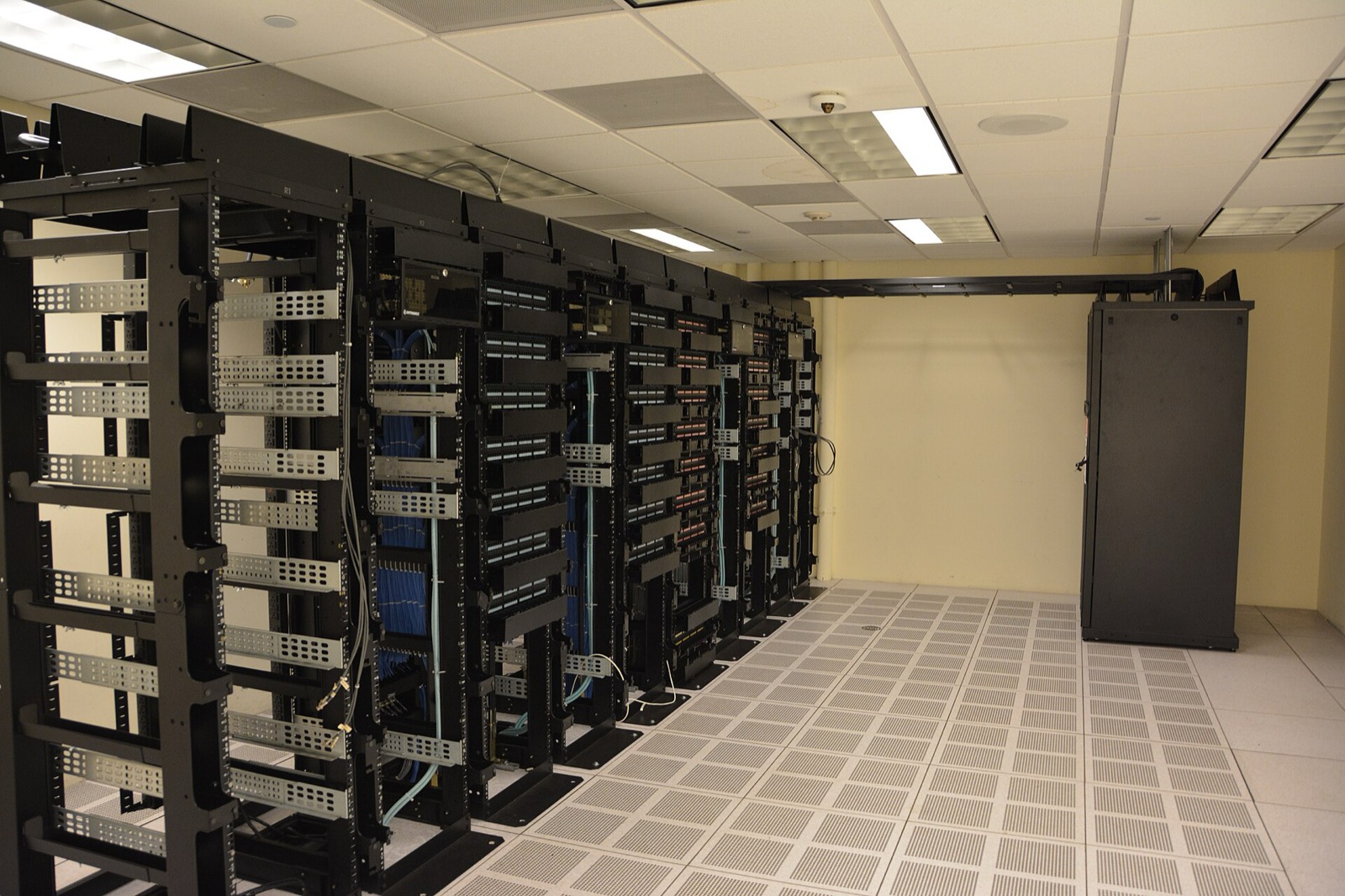
Photo: Carl Lender, Datacenter Server Racks, via Wikimedia Commons, CC BY 2.0. Resized. Illustrative only, not an Oracle site.

Data centre reliability depends on how critical power, cooling and fire systems are maintained, tested and changed, not just on how they were designed. This checklist helps facilities and operations teams review those systems and the processes around them, so maintenance reduces risk rather than adding to it.
Use it alongside your manufacturers' instructions, your site's design documentation and the advice of competent specialists. It is a starting point, not a substitute for a site-specific maintenance regime.
The legal baseline
Several general duties apply to data centre plant in Great Britain:
- The Electricity at Work Regulations 1989 require electrical systems to be maintained, as necessary, to prevent danger so far as is reasonably practicable. Regulation 14 restricts live working to cases where it is unreasonable for the conductor to be dead, reasonable to work on it live and suitable precautions are taken. HSE's HSG85 gives guidance on safe working practices.
- In England and Wales, article 17 of the Fire Safety Order requires fire safety facilities, equipment and devices to be subject to a suitable system of maintenance and kept in efficient working order and good repair.
- HSE notes that diesel and gas oil are now classified as flammable liquids. The Dangerous Substances and Explosive Atmospheres Regulations 2002 (DSEAR) require employers to assess and control fire and explosion risks from dangerous substances, including generator fuel.
Reliability practice goes further than these minimums, but they shape how work is planned and recorded.
Critical power: UPS
- Keep an up-to-date single line diagram that matches what is installed.
- Follow the manufacturer's maintenance schedule for each UPS module, including firmware and capacitor or fan replacement intervals.
- Monitor batteries for voltage, temperature and internal resistance or impedance trends, and act on cells that drift.
- Inspect battery rooms or cabinets for corrosion, leakage, swelling and ventilation.
- Check that bypass and maintenance bypass arrangements are understood, labelled and covered by a written switching procedure.
- Record load per module and per path, so you know the real redundancy before taking anything out of service.
Critical power: generators and load bank testing
- Run generators on a planned schedule, and record start times, transfer times and any alarms.
- Test under load. Running generators lightly loaded for long periods can cause problems, so many operators use periodic load bank testing to prove the set at a meaningful load.
- Test the full transfer sequence, not just the engine, so that changeover switching, controls and protection are proven together.
- Manage fuel: tank levels, fuel quality sampling, water and contamination checks, and resupply arrangements.
- Keep fuel storage, bunding and spill arrangements under your DSEAR risk assessment.
- Inspect batteries, chargers, coolant, filters and exhaust systems on the generator itself.
Cooling
- Maintain CRAC and CRAH units, chillers, pumps and dry coolers to the manufacturer's schedule.
- Check that redundancy (for example N+1) is real: test that a unit can be lost without temperatures exceeding agreed limits.
- Trend supply and return temperatures and humidity at rack level, not only at the units.
- Keep containment, blanking panels and floor tile layouts in good order, as airflow problems often look like cooling capacity problems.
- Where refrigerant systems contain F gas, follow the GOV.UK guidance on checking F gas equipment for leaks and use suitably qualified technicians.
Fire detection and suppression
- Aspirating smoke detection (ASD, often known by the VESDA brand name): check pipe networks, sampling holes, airflow readings and alarm thresholds, and record transport time tests.
- Fire alarm interfaces: test cause and effect, including links to suppression release, ventilation shutdown and door holders.
- Gas suppression: inspect cylinders, pressures and weights, actuators, manual release and abort controls, and warning signage. Keep the room enclosure integrity under review, because unsealed penetrations can allow extinguishing gas to escape. Confirm when the enclosure was last tested.
- F gas suppression systems: GOV.UK guidance requires leak checks at set intervals based on the CO2 equivalent of the gas, and a leak detection system where equipment contains F gas equivalent to 500 tonnes or more of CO2.
- Passive protection: fire stopping around new cable routes and containment should be reinstated after every change.
Maintenance windows
- Plan work in advance with a method statement, risk assessment and switching procedure for each critical activity.
- Confirm the redundancy position before isolating anything, and agree hold points and rollback steps.
- Notify customers or internal stakeholders according to your agreed notice periods.
- Assign a single person in charge of the window, with clear authority to stop work.
- Record what was done, readings taken and any alarms raised, and close the window formally.
Change control
- Treat every change to critical infrastructure as a controlled change, including temporary works.
- Assess the impact on redundancy, protection settings, fire detection and suppression, and cooling.
- Update drawings, single line diagrams, cause and effect matrices and asset registers when the change is complete.
- Review incidents and near misses, and feed lessons into procedures.
How Oracle can help
Oracle FM delivers live-environment works for Tier III and Tier IV data centres, with phased commissioning, redundancy maintenance (N+1 and 2N) and zero downtime delivery planning. Our work covers critical power, CRAC and CRAH cooling, and fire systems including VESDA detection and gas suppression. Read more on our data centre services page.
For wider support, see our electrical, EICR testing, active fire protection, fire alarm and emergency lighting maintenance and fire stopping and compartmentation survey services. To book a briefing, contact our team.
Subscribe to our newsletter
Get the latest insights delivered directly to your inbox.